The mosaic
The Last Supper mosaic in Vienna
A life-size mosaic copy of Leonardo's Last Supper hangs in Vienna's Minoritenkirche: who made it, why in mosaic, and how it reached the church.
Book a seat in the Minoritenkirche ↗Quick answer
The Minoritenkirche holds a life-size mosaic copy of Leonardo's Last Supper, about 9 metres wide, made by the Roman mosaicist Giacomo Raffaelli. It was ordered under Napoleonic rule, finished after Napoleon's fall, bought by the Austrian emperor and given to the church, where it was set up in the 1840s.
What you are looking at
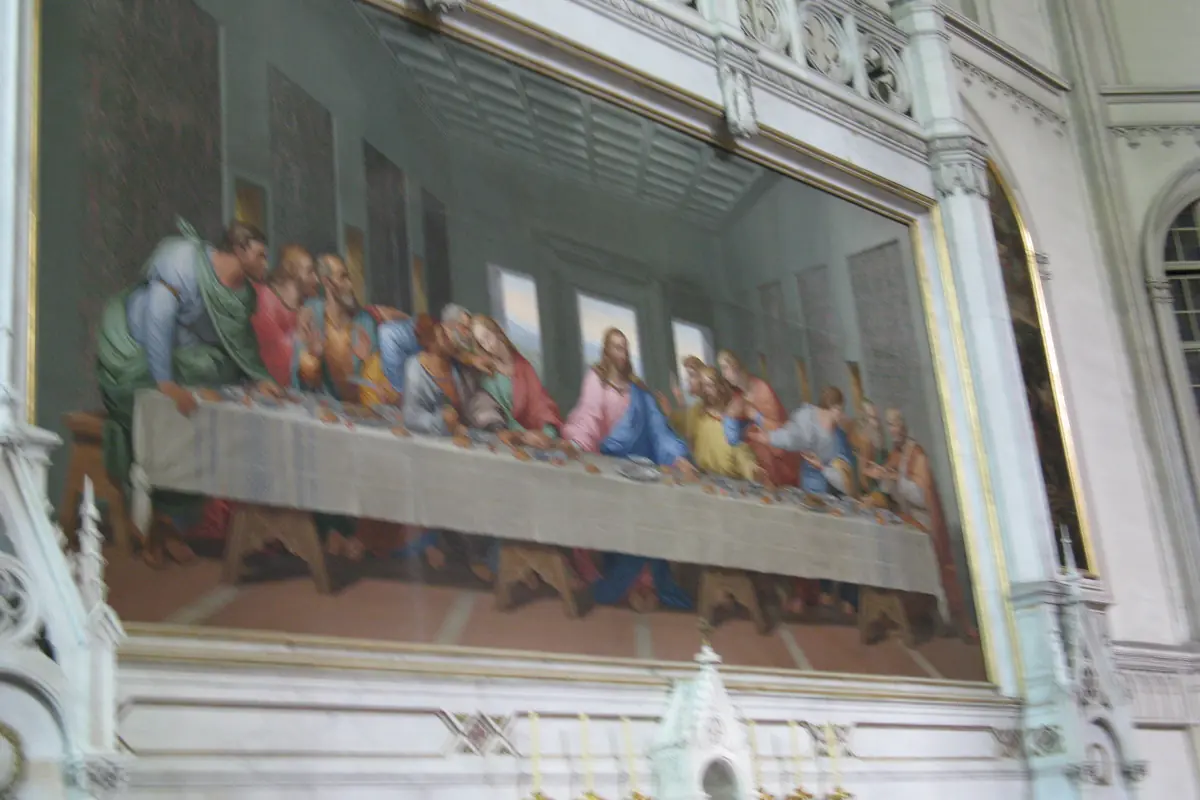
On a side wall of the church hangs a full-size copy of Leonardo da Vinci's Last Supper, made not in paint but in mosaic. It measures about 9.18 by 4.47 metres and weighs roughly 20 tonnes. It sits in a Gothic-style frame, with the long table across the width and Christ at the centre, as in the original in Milan. It is easy to find with your eyes while you wait for the music to begin.
Why copy it in mosaic
The original is Leonardo's wall painting at Santa Maria delle Grazie in Milan, made in tempera on a dry wall rather than in fresco. The paint began to deteriorate soon after he finished, and by 1556 the biographer Vasari described a muddle of blots. A copy in mosaic was meant to last. The Innsbruck university's artists' dictionary puts the idea plainly: Leonardo's original was already badly damaged, and the copy was to stay imperishable, which is why it was made as a mosaic but at the original size.
The mosaicist
Giacomo Raffaelli was born in Rome in 1753 and trained there. He worked first as a sculptor and only later as a mosaicist. In 1804 he was called to Milan to run a school of mosaic. There he made the Last Supper after a painted copy by Giuseppe Bossi, which Bossi had finished in 1808 or 1809. The dictionary dates the mosaic itself to 1810 to 1817, while other sources say it was begun about 1806 and finished by 1814, so the exact years vary with the source. Raffaelli died in Rome in 1836.
Napoleon's order
Milan was under Napoleonic rule when the work was ordered. Some sources credit Napoleon himself with the commission, others his stepson Eugène de Beauharnais. Either way, the mosaic was unfinished when Napoleon abdicated. With the fall of his empire, Milan was again Austrian, and the emperor Franz II bought the unfinished work. That change of owner is why a mosaic ordered in Milan ended up in Vienna.
From Milan to Vienna
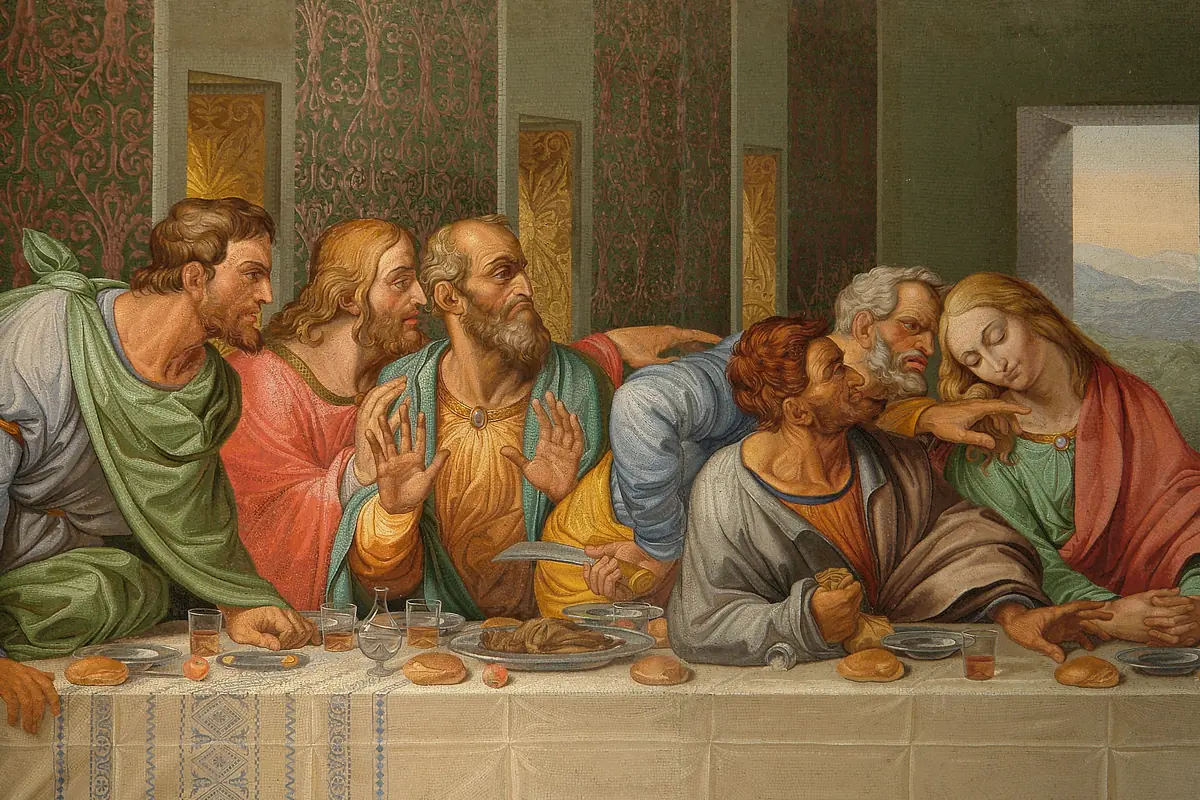
After Napoleon's fall Emperor Franz ordered the mosaic brought from Milan to Vienna. It arrived in pieces and was stored dismantled in a warehouse of the Belvedere, the palace that was meant to display it. It turned out to be too large for the building. The mosaic waited there for years, because a work 9 metres wide and 20 tonnes in weight is not easy to place. A church wall was a better fit.
Into the church
Franz's successor, Emperor Ferdinand I, gave the mosaic to the Italian congregation that owned the Minoritenkirche. It was set up on the wall in 1845 to 1847, and the Vienna city history wiki records that the emperor paid the cost. The Gothic-style frame was designed by August von Stäche to suit the medieval setting. The gift made sense: the church was the Italian national church, and the work was a copy of an Italian masterpiece by an Italian artist. It has hung there ever since, and it is the church's best-known object.
Seeing it at a concert
Photography inside is not allowed during the concerts, so look rather than shoot. The best time is the minutes before the music begins, when the church is lit and you are already seated. If you want to see the mosaic closely, ask the church about its own visiting arrangements, which are separate from the concert ticket. The original in Milan is the other half of the comparison, and Milan keeps its own rules for seeing it. The Vienna copy is the one you can sit under while the strings play.
Frequently asked questions
Who made the Last Supper mosaic in Vienna?
Giacomo Raffaelli, a Roman mosaicist who ran a school of mosaic in Milan, working from a painted copy by Giuseppe Bossi.
How big is it?
About 9.18 by 4.47 metres and roughly 20 tonnes in weight.
Can I photograph it during the concert?
No. Photography inside, flash and video recording are not allowed at the concerts.
Sources